“Nothing wrong with shooting as long as the right people get shot!”
-- Harry Callahan from Magnum Force
“We all got it coming, kid.”
-- William Munny from Unforgiven
“Ever notice how you come across somebody once in a while you shouldn't have messed with? That's me.”
-- Walt Kowalski from Gran Torino
Clint Eastwood is a cinematic atlas of Post-World War II America. He is an icon. No one would argue with this premise. He is a towering presence in front of and behind the camera. I used to think he was the closest thing we have to John Huston, but I was wrong. Eastwood is his own man. He has proven himself time and time again. He embraces the world of filmmaking and bends it to his will. He paid attention to the great directors he worked with in the early years of his career: Sergio Leone, Don Siegel and Ted Post. I remember in the late Seventies when Play Misty For Me, High Plains Drifter and The Outlaw Josey Wales were shown on television, I would watch them with my Mom. These films are as fresh now as when they were first released. Each film that followed, good and bad, showed an enormous dedication and respect for the craft of filmmaking. If there is a John Houston comparison, than it is that they both improved as they aged. Who could argue the quality of John Houston’s late films-- Under The Volcano and Prizzi’s Honor? He left us with an enormous body of work which still excites us. In White Hunter Black Heart, Eastwood portrays a very thinly veiled John Huston like director. I think it is safe to say that Eastwood admired and learned from John Huston. Clint Eastwood shows no signs of slowing down. Whenever he hits a bump in the road like Blood Work, he comes back with films like Mystic River, Million Dollar Baby, Flags Of Our Fathers and Letters From Iwo Jima. I know that there are many who feel Million Dollar Baby is an over rated film. I am sure Annette Benning hates it as much as Boys Don’t Cry. Did it deserve to win the Oscar for Best Picture? I do not know; there were a lot of great films to pick from in 2004. What I do know is that it was Eastwood’s Frankie Dunn that was the highlight of the film for me. Hilary Swank and Morgan Freeman were good, but there is nothing quite like watching Clint Eastwood in front of the camera.
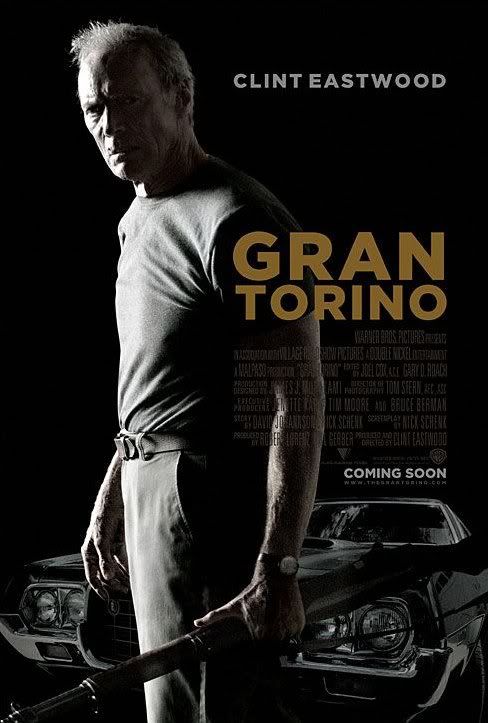
Gran Torino is a pleasure to watch. No other living actor could portray the bigoted, Korean War veteran, Walt Kowalski in Clint Eastwood’s Gran Torino. We would not accept anyone else but Clint Eastwood playing the character. I really do not even think that Jack Nicholson or Tommy Lee Jones could portray this character as authentically as Eastwood has done. It is Eastwood’s rich career of characters that has led us to Walt Kowalski. He has a little bit of Harry Callahan, Josey Wales, Thomas Highway, William Munny, Frank Corvin and Frankie Dunn mixed with Archie Bunker. In another time, we might have seen John Wayne or William Holden play this part. Speaking of John Wayne, Gran Torino is reminiscent of Don Siegel’s The Shootist where John Wayne played a dying gunfighter who wants to die with dignity. What made the film so emotionally powerful was that Wayne was dying of cancer in real life. It was his final performance. Is Gran Torino Clint Eastwood’s version of The Shootist? Eastwood has stated that this would be his final screen performance, but by no means the last film he will direct. Yet, he gives an incredible and moving performance similar to John Wayne’s J.B. Books. In all my years, I would have never compared John Wayne to Clint Eastwood, but there are times when the two have collided. Is not Heartbreak Bridge just a far superior version of The Green Berets? Both films are shamelessly jingoistic. Still they are products of different times. I doubt John Wayne would have had anything to do with a World War II film as cynical as Flags Of Our Fathers or would have appreciated Letters From Iwo Jima. I am sure he wanted nothing to do with Kelly’s Heroes. John Wayne’s view of the Western was far different from Clint Eastwood’s. I always preferred Eastwood, but there is no denying the influence and power of the great John Ford Westerns in which John Wayne starred. Gran Torino is a great character study in the same way as Mickey Rourke’s performance in Darren Aronofsky’s The Wrestler. In both films, the two legendary actors are tailor made for their roles. We cannot imagine any other actors playing Walt Kowalski and Randy “The Ram” Robinson. To be honest with you, I would never want to.
They do not make films like Gran Torino anymore. Mr. Eastwood has made a film that is very much about America and what the ideal of America is or was. Walt Kowalski is a dying breed. He is in many ways like the aging gunfighter who knows his time is coming to a close. He represents an America that is close to extinction. When we meet Walt, he is widower whose only pride and joy is in his flawlessly maintained 1972 Gran Torino fastback. It is fitting that his car, like him, is a rare piece of American Steel from the Ford assembly line. We learn that he used to work on the Ford assembly line. He worked during the industry’s heyday. He installed the steering column on his car. The film takes on added poignancy because we are witnessing the end of the great American automobile industry era. It is very fitting that the film takes places in Detroit-- a city whose industry must be saved as I write this. Walt’s whole life is an endangered species. The career he once had is going to be as obsolete as he is. Walt is retired; he sits on his porch with his faithful yellow Labrador, Daisy, and drinks beer while offering colorful commentary on the world around him. Foreigners keep moving in. Walt is a bitter man who cannot understand all the changes going on around him. Walt drinks as much beer in this film as Walther Matthau’s Morris Buttermaker did in The Bad News Bears. He is walking, talking advertisement for political incorrectness. The character seems outdated and tired at the dawn of the Presidency of Barack Obama. He has nothing kind to say about anyone. He is as bitter as they come. He snarls and growls at every chance. If Walt was played by another actor, the film would have come across as caricature. Having said that, Eastwood could have fallen into self-parody many times in the film, but does not. If he had done this film twenty or thirty years ago, it would have come across as self-parody. I think his character, Thomas Highway in Heartbreak Ridge does fall into self-parody and that was back in 1986. He has enough bile to make Archie Bunker feel at home, but he hates everyone in the same way as Dirty Harry. While he deplores the sight of the Hmong refugee family that lives next door to him, he detests with even more vigor the young neighborhood priest, Father Janovich, played by Christopher Carley. Janovich wants him to come to confession because Walt’s late wife wanted Walt to go to confession, but Walt has no interest to confessing to a priest who just got out of the seminary.
If the film was just Eastwood shouting out racial slurs, it would not have quite impact it does have. What gives the film its true impact is Walt’s relationship with the Hmong immigrant family. One night, Thao (Bee Vang), the teenage son who lives next door, breaks into Walt’s garage and attempts to steal the prized Gran Torino as part of a gang initiation. He fails miserably and nearly loses his life to the car’s angry owner. Thao’s family, led by his sister, Sue (Ahney Her) forces Thao to work for Walt. They set up an arrangement where Thao will do household chores for Walt. Walt is not thrilled with the idea, but reluctantly goes along with it. He seems like the most unlikely surrogate father for Thao. Walt’s relationship with his adult children is strained at best. After his wife’s funeral that opens the film, his children want him to live in a retirement community. Walt becomes an unlikely mentor to Thao and even to Sue. One night, Hmong gangbangers threaten the family. Walt comes out with his rifle. Walt means business and he has no time for this nonsense. He threatens the gang and they leave. He becomes a hero to the immigrant community; they leave gifts on his doorsteps. In another scene, he rescues Sue and a male friend from a trio of gangbangers in a bad section of town. He becomes their protector. It is a transformation that no one expects, especially Walt. His scenes with Thao reminded some of the relationship between Ralph Macchio and Pat Morita in The Karate Kid, but it really reminds me of the relationship between John Wayne and Ron Howard in The Shootist and the relationship between Alan Ladd and Brandon De Wilde in Shane. Walt’s relationship with the family will lead to increasing and more violent encounters with the gang. His relationship with the family of Hmong immigrants leads to a transformation in his own personality. They are as wary of outsiders as he is. They have their prejudices that mirror his bigoted self in some ways. Although none of them have the acid tongue he does.
In many ways, Gran Torino is a modern western, a 21st Century answer not only to the Dirty Harry films, but also to The Man With No Name trilogy of westerns he made with Sergio Leone. Mr. Eastwood is very aware of the characters he has played over the last fifty years. Walt Kowalski is the latest of his outlaws to roam on the screen. This is where Gran Torino greatly differs from The Shootist. The Shootist was about the end of lives and the ways of doing things as was Shane and to a greater degree The Wild Bunch. It really is William Holden’s Pike Bishop in The Wild Bunch who is the perfect symbol of a man who has outlived his times. I see more of Pike Bishop in Walt Kowalski, but also in Tommy Lee Jones’s Sheriff Ed Tom Bell in No Country For Old Men. In Gran Torino, Clint Eastwood has remodeled the hero and his image at the dawn of the 21st Century. He has given us a Dirty Harry for our times, for the Barack Obama era. Walt Kowalski is an older, if not wiser Harry Callahan. In his own way, Walt changes throughout the film. In the end, he has to do the right thing. In the end, he is the very embodiment of change.